Context first
Digital security choices depend on the story, the people involved, the places the work moves through and the systems that may touch it. SSN begins with context before suggesting practical steps.

Digital security approach
SSN helps storytellers build careful workflows for cross-border and complex storytelling work.
SSN treats digital security as part of a wider storytelling practice. It sits alongside consent, physical safety, wellbeing, legal awareness and responsible production.
Our aim is not to make storytellers afraid of technology, or to make every project feel heavy. The aim is to help teams make clearer decisions about communication, project material, access, movement and work with contributors as conditions change.
Security is not a one-time technical setup. It is a living workflow.
Practical digital security matters. But it only becomes useful when it is chosen for the right context, used consistently and integrated into the real rhythm of a project.
SSN helps storytellers move from “using tools” to building practical, context-aware working habits.
Overview
Different projects ask for different choices. A personal essay, a community collection, an investigative documentary and a cross-border project do not need the same setup. SSN helps teams understand the difference and choose proportionate measures.
Digital security choices depend on the story, the people involved, the places the work moves through and the systems that may touch it. SSN begins with context before suggesting practical steps.
SSN training introduces practical ways to strengthen accounts, communication and project storage. The focus is not only on individual tools. The deeper question is when a practice is useful, who needs access, how strongly it should be adopted and how it fits into the life of a project.
Teams are encouraged to collect less, store less and share less personal or private information where possible. This is not about secrecy for its own sake. It is about reducing unnecessary circulation for storytellers, contributors, collaborators and communities.
A secure storytelling workflow should support thoughtful action. It should not make storytellers feel frozen, isolated or blamed. SSN approaches digital security as a practice of care for contributors, teams, future audiences and the people connected to the work.
A four-day training can introduce habits, questions and shared language. But secure storytelling does not end when the workshop ends. Circumstances change. Teams change. A project may become more visible or more complex over time. SSN therefore treats follow-up, review and adaptation as part of the work.
How this connects
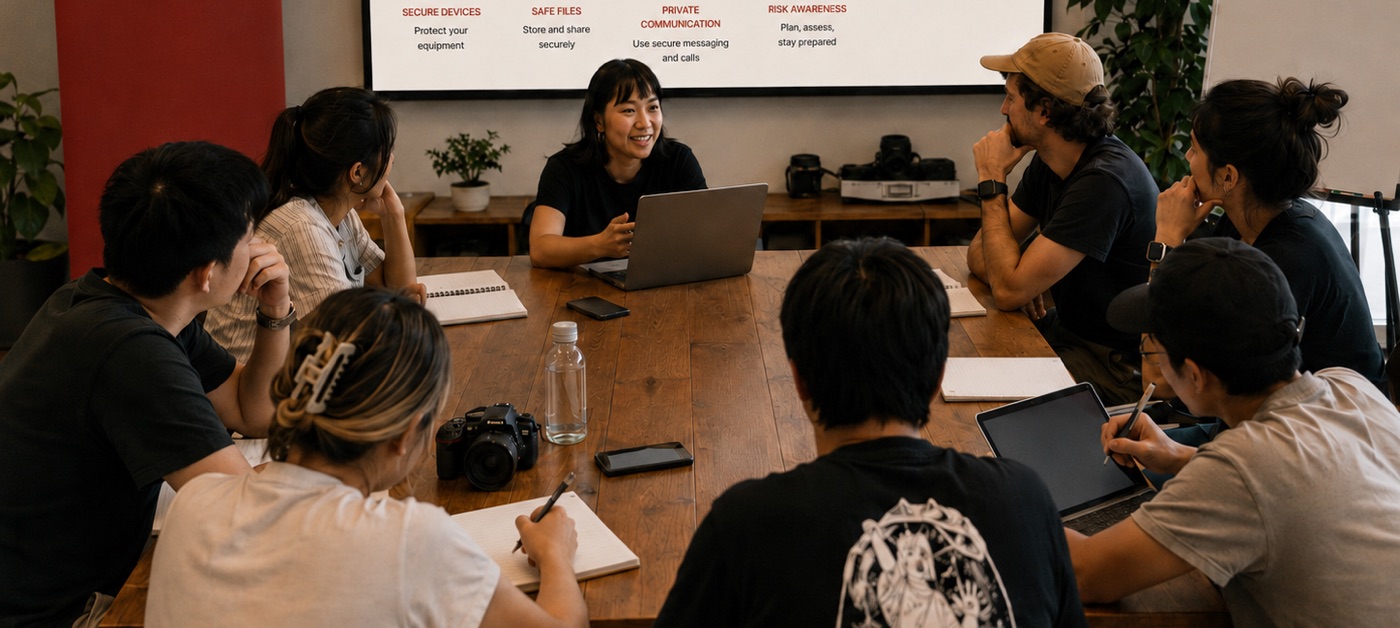
SSN training can take the form of a 1-hour webinar, a full-day workshop or a 3- to 4-day boot camp. SSN training helps storytellers understand digital security as part of their wider creative and ethical practice.
Participants learn practical ways to strengthen accounts, communication habits, project storage and everyday digital routines. These are introduced through broad storytelling scenarios, so participants can decide what level of care is appropriate for their own work.
The focus is not only tool use, but judgement: what needs care, for how long and with what level of effort.
Training can be shaped for filmmakers, artists, researchers, community groups, festival cohorts or organisations supporting projects where care, consent and context matter.
Project support helps a team look closely at a specific part of a production workflow.
This may include how material and information are collected, stored, shared and carried across a project.
The work stays proportionate. SSN does not ask for unnecessary project detail. We can often work from categories, workflows and patterns rather than names, raw materials or private project details. We help teams design careful workflows around what they already know, what needs careful handling and what they are ready to change.
Project support can include workflow review, context mapping, digital setup guidance, contributor planning, safer travel preparation, storage and sharing planning and follow-up.
SSN works with partners, funders and aligned organisations to support careful storytelling practice across borders and complex contexts.
We are interested in practical collaborations that strengthen safety, consent, ethics and sustainable ways of working.
Partnerships may include workshops, project clinics, cohort training, trainer exchange or support for a focused programme. We keep public descriptions broad and agree details carefully.
SSN also cares about the people in front of the camera.
Contributors, communities and local organisations may be approached for stories and experiences that carry meaning, urgency or public interest. A film team may arrive with good intentions, but different expectations about access, portrayal, timing or what happens after a story is shared.
SSN can help people think through consent, boundaries, material use and responsibility before a project moves forward. This can include what to ask, what to expect, when to pause and how consent may need to be revisited over time.
The focus is practical and proportionate: clearer expectations, stronger shared care and safer ways to take part in storytelling.
Storytelling cultures
We believe secure storytelling is not a specialist layer added at the end of a project. It is part of how a story is made.
A careful storytelling workflow asks:
By asking these questions early and returning to them throughout the life of a project, storytellers can make stronger, calmer and more responsible decisions.
SSN does not train paranoia. We train proportion, adaptation and care.